
Practical guide
How to Find Web Design Clients: A Practical Guide for Freelancers
Learning to find web design clients can feel difficult when you are new to freelancing. A repeatable process makes it manageable: choose a focused offer, research businesses, qualify a real need, make a respectful approach, and track what happens next.
1. Define your ideal client and service offer
Start with work you can explain clearly. A restaurant may need a menu and reservation path, a clinic may need clearer services and appointment requests, and a local service business may need an easier way for customers to enquire. Real estate agencies may need property pages that make the next step obvious. These examples are leads to investigate, not proof that every business needs a redesign.
Choose one niche, one area, and one useful outcome. A focused offer, such as improving a booking journey or creating a clear service website, makes finding website design prospects and writing a relevant message easier.
- Choose a niche and location you understand.
- Describe one service and the customer task it improves.
- Write down reasons to include or exclude a prospect.
2. Research local businesses
Use legitimate public sources: local search results, business directories, industry listings, company websites, and public social profiles. Build a short prospect list you can check properly instead of collecting hundreds of names with no context.
For each business, confirm its name, location, current web presence, and a public contact route. Keep a source link and one clear observation. This makes your web design outreach accurate and helps avoid contacting the wrong company.
- Search one category in one city or district.
- Confirm the business name and location.
- Record a source and a short observation.
3. Find businesses without websites
A missing website button in a directory or Maps listing can be a useful signal. Check the business name and location separately before making a claim. It may use a website that is not connected to the listing, a booking platform, or a social profile as its main presence.
Some businesses deliberately operate without a standalone site and may not be suitable prospects. Look for an opportunity where a website could support a real customer task, rather than simply an absent link.
4. Identify outdated or underperforming websites
Look for observable issues: broken pages, missing or outdated service details, hard-to-read mobile layouts, unclear contact options, and booking steps that are difficult to complete. A subjective dislike of a design is not enough evidence for a pitch.
Write down one specific customer-facing observation and a possible improvement. Review the site yourself before treating any audit finding as a sales opportunity.
5. Qualify your prospects before you spend time
Good freelance web design clients are a fit for your service, active in the market you serve, and reachable through a public business channel. Qualification prevents you from creating proposals for companies that are inactive, outside your scope, or already well served by their current website.
Use a short checklist. Can you verify the business identity? Is there a real website or customer-experience observation? Can your service address it? Is there a legitimate public contact route? If the answer is unclear, keep researching or move on.
- Check business activity and service fit.
- Confirm one verifiable observation.
- Decide on a practical first offer.
6. Find the right business contact
Prefer the channel a business has published: its contact page, business email, phone number, directory listing, or a decision-maker profile that is clearly public. Avoid guessed personal addresses and respect the channel the business uses for enquiries.
Email verification can help identify format, domain, or mail-routing issues when available. It is a signal, not a guarantee that a message will reach a person or receive a reply. Record the source of every contact detail and stop when someone opts out.
7. Prepare a personalized pitch
A useful pitch starts with one verified observation, connects it to a possible customer benefit, and asks a small question. Keep it short. Do not claim lost revenue, rankings, or technical problems you cannot prove.
Example: Hi [Name], I was looking at [Business] and noticed the mobile site makes the booking link hard to find. I design clear booking flows for local service businesses. Would it be useful if I sent a brief idea for a simpler path? This is specific, professional, and easy to decline.
- Use a real observation.
- Offer one relevant next step.
- Make it easy for the recipient to say no.
8. Create a website concept to demonstrate value
A small mockup, homepage concept, or booking-flow outline can help a prospect understand your direction. Use only verified facts, label it as an independent proposal, and ask permission before presenting it publicly or representing it as the business's official site.
Do this selectively. A concept is most useful after you have qualified the business and can connect the proposed change to a genuine customer task.
9. Use freelance platforms and professional networks
Referrals, Upwork and similar marketplaces, LinkedIn, local networking groups, and industry communities can all produce freelance web design clients. Pick one or two channels that fit your niche instead of trying to be active everywhere at once.
On platforms, lead with relevant work and a clear offer. In communities, contribute useful answers before asking for work. Referrals are easier to earn when past clients and peers can quickly describe the problem you solve.
10. Use content marketing and local SEO
A focused portfolio, honest case studies, niche-specific guides, and practical local content can help the right people understand your work over time. A designer serving clinics, for example, could show how they make appointment information clearer.
Content supports trust; it does not guarantee rankings or client acquisition. Publish material that answers questions your intended clients actually have, then use it to make follow-up conversations more useful.
11. Track follow-ups and lead activity
Record the outreach date, channel, reply, next step, meeting, and outcome for every prospect. A respectful follow-up can be appropriate when there has been no reply, but repeated messages after a decline or opt-out are not.
A beginner-friendly routine is simple: research a few businesses, qualify the strongest ones, send tailored messages, and review outstanding follow-ups once a week. Consistency matters more than a large list.
12. Use a simple prospecting workflow with AR Sales Agent
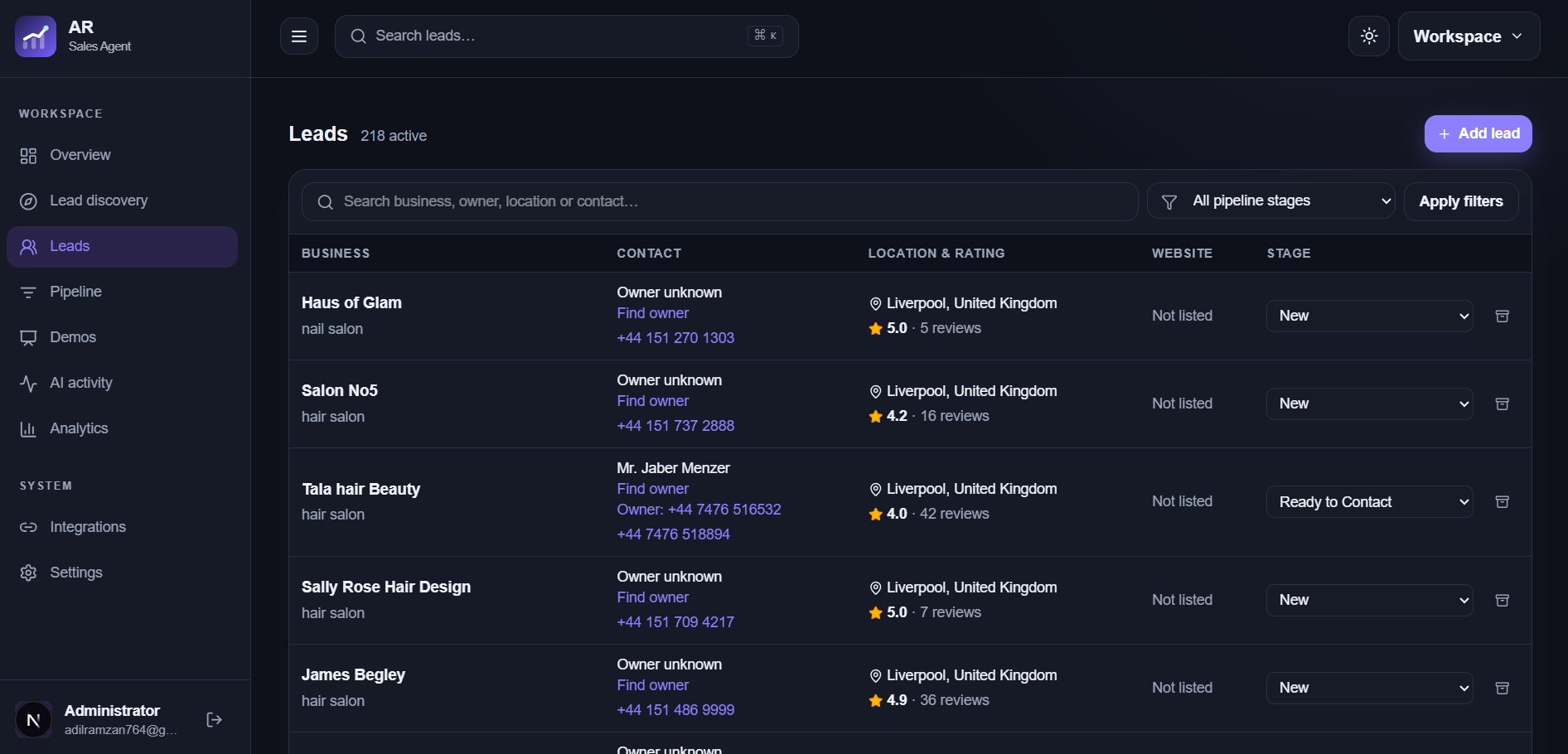
AR Sales Agent can help you discover potential business leads, review business details, assess observable website signals, prepare an outreach draft, and keep follow-ups tied to the lead. You still review the evidence, recipient, and wording before making contact.
Keep research and decisions in one place: discover candidates, qualify an opportunity, save a clear observation, prepare a tailored concept or message, and track the next action. It is useful even when you decide a prospect is not a fit.
Explore lead generation for web designers Try the free business lead finder
13. Common mistakes and a simple weekly action plan
Avoid generic outreach, weak targeting, unverified contact details, excessive follow-ups, and treating lead volume as the goal. A small list with real notes will usually produce better conversations than a large sheet of names.
As an illustrative weekly plan, spend one session researching 10 to 15 businesses, one session qualifying the strongest five, one session preparing a few personalized messages, and a short weekly review on replies and next actions. Adjust the numbers to your available time and niche; they are activity examples, not performance guarantees.
Frequently asked questions
How do beginners find web design clients?
Start with one clear service, one niche, and a short list of businesses you can research carefully. Referrals, freelance platforms, local business research, and professional communities are practical starting points.
How can I find businesses that need a website?
Look for a missing website listing, an unclear customer path, outdated public information, or a contact and booking process that is hard to use. Verify the observation before contacting the business.
How do I approach a business about building its website?
Use one factual observation, describe a possible benefit, and ask a simple question. Keep the message short and give the recipient an easy way to decline.
Where can freelance web designers find clients?
Useful channels include referrals, freelance marketplaces, LinkedIn, local business research, networking groups, industry communities, and content that demonstrates a focused service.
How can I find web design clients without paid advertising?
Build a focused prospecting routine, ask for referrals, use relevant communities and marketplaces, publish useful portfolio content, and make researched outreach to businesses that fit your service.